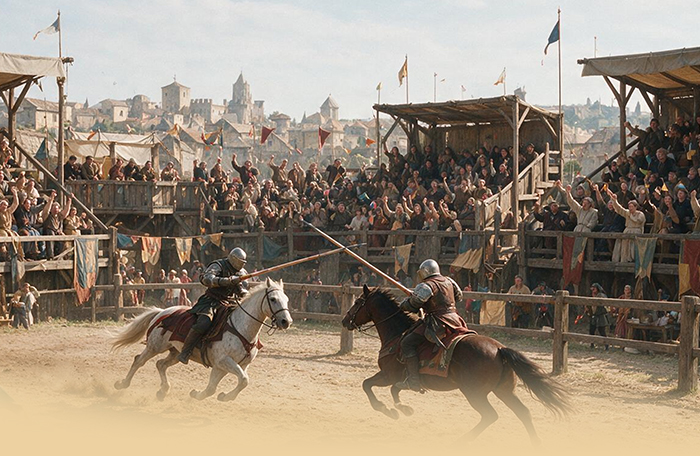

While the word “chivalry” typically conjures up images of knights in gleaming armour on horseback, the concept circles much more than male prowess. It is a rich tradition intertwined with the evolution of language, literature and culture. Answer the following questions to test your knowledge of chivalry and its legacy.
| 1. |
Which title, originally published in two parts (in 1605 and 1615) and considered a prototype of modern novels, features the adventure of an ageing knight on his old horse enthralled by chivalric romances?
|
|
| 2. |
In the Arthurian legend, which object, said to have been crafted by Merlin and given to King Arthur as Queen Guinevere’s dowry, symbolises equality among knights?
|
|
| 3. |
Which epic poem is based on the historical Battle of Roncesvalles (Roncevaux) in 778 and becomes the archetypal chanson de geste (song of heroic deeds)?
|
|
| 4. |
Which 12th-century French poet wrote Arthurian romances that inspired the later concept of “courtly love” (amour courtois) to portray the adulterous love between Sir Lancelot and Queen Guinevere?
|
|
| 5. |
Knightly effigies are often depicted with crossed legs in many churches across England and Wales. According to folk legend, this posture indicates that the knight:
|
|
| 6. |
In the Middle English poem Sir Gawain and the Green Knight, what challenge does the Green Knight cast before Sir Gawain when disrupting King Arthur’s Christmas celebrations?
|
|
| 7. |
To fulfil a vow made in the Holy Land, which chivalric military order did William Marshal, eulogised as “the best knight that ever lived”, join before his death in 1219?
|
|
| 8. |
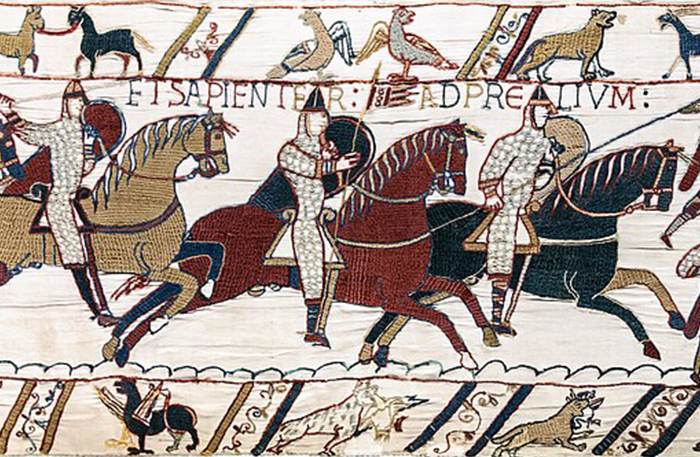
Which famous embroidery depicts scenes of the Norman Conquest of England in 1066, featuring knights and archers in combat?
|