


Economists tend to assume that human beings are rational individuals. Yet a glance at history might suggest otherwise. We are too often creatures who are caught up in greed and prone to mass euphoria. Perhaps no words offer a more chilling reminder of our propensity for folly than the Greek saying: “Whom the Gods would destroy they first make mad.”
History is replete with examples of irrational exuberance and market madness, including two of the earliest asset bubbles: the Tulip Mania that gripped Holland in the 1630s and the South Sea Bubble in 1720. As light-hearted as the word “bubble” may sound, asset bubbles blow up and burst from time to time, leaving behind not a whisper of dreams but a cacophony of agony and anger from those who get their fingers burned.
The cautionary tale of the Tulip Mania began with the arrival of exotic tulips from the Ottoman Empire in the late 16th century. Rare gems to the European eye, these blooms captivated the hearts of horticulturists in the Dutch Republic with their prolific beauty. Botanists competed to breed ever more charming tulip cultivars for exchange in a network of botanical scholars, connoisseurs and collectors. Intriguingly, the most sought-after tulips were those striated, as a result of virus infection, with dramatic hues of red, orange and yellow. As this “network of friendship” grew, people started trading tulip bulbs and eventually contracts for their future deliveries in what we would call a futures market today.
Enticed by stories of easy profits from the tulip trade, droves of speculators, some from as far as Paris, flocked to the market, aggressively bidding up prices for tulip bulbs. As prices skyrocketed, ordinary folk, from carpenters to bricklayers, jumped on the bandwagon in the hope of quick riches from such frenzied trading. To fuel the gold-rush atmosphere, brokers accepted payment-in-kind, including herds of cattle, tracts of land and even a thousand pounds of cheese, as collateral for tulip contracts.
The winter of 1636 to 1637 witnessed sheer market madness, where an ordinary tulip bulb changed hands for 220 guilders, roughly the equivalent of an average annual wage. The rarest and most coveted bulb, the Semper Augustus, was said to fetch an eye-watering 10,000 guilders, a sum that, in the words of historian Mike Dash, was “sufficient to purchase one of the grandest homes on the most fashionable canal in Amsterdam”. Yet the tide turned unexpectedly in February 1637 as demand for tulips vanished into thin air. The tumbling prices that followed left many bankrupt and destitute, dashing their rags-to-riches dreams.
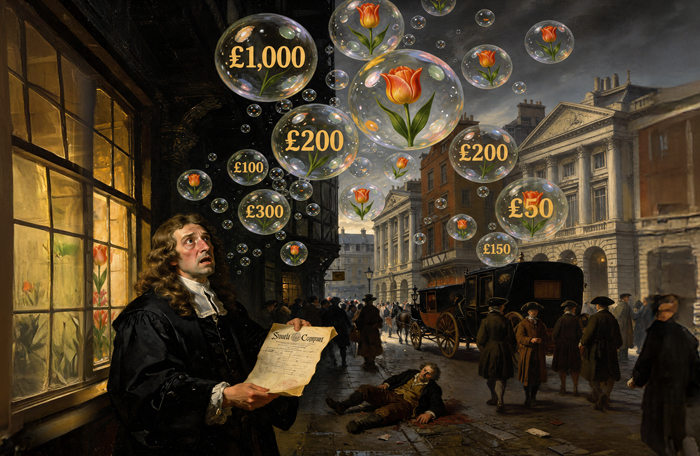
While history does not repeat itself, it often echoes. Less than a century after the collapse of Tulip Mania, another asset bubble blew up across the English Channel. London’s Exchange Alley, the centre of stock trading, hosted one of the earliest stock market booms. Founded in 1711, the South Sea Company started as a public-private partnership to swap national debt for shares, with assets including the government’s payment of 6% interest a year to shareholders as dividends. Its intricately close ties with the government and the monarchy made it an initial darling among investors until early 1720 when it proposed acquiring a national debt of £31.5 million for a mere £7.5 million. For such an audacious acquisition plan to succeed, a wave of fresh capital was essential through issuing and selling an extraordinary number of shares to investors.
To lure prospective shareholders, the South Sea Company took an innovative step of offering shares to the public via an instalment subscription plan throughout 1720, in addition to offering loans for eager investors. Such sales instruments, along with an aggressive advertising campaign, drove the company’s stock price up from £125 in January 1720 to nearly £1,000 in July. With such lofty valuation built on a precarious foundation, it was just a question of time before the bubble burst.
We like to imagine that financial manias only prey on the naïve and credulous, but the truth is more sobering. Even the most brilliant minds can find themselves seduced by the glittering promise of wealth. Sir Isaac Newton, one of the greatest scientists in history, was an astute investor and stock picker. After skilfully exiting his South Sea Company shares just before the crash, Newton entered the fray again at its peak in July and, like many others, lost a fortune when the stock price plummeted below £200 in October. He famously remarked, “I can calculate the motions of the heavenly bodies, but not the madness of people.”
As the old adage goes, “Fool me once, shame on you. Fool me twice, shame on me.” Unless we distil wisdom from the lessons of the past, we too risk repeating these mistakes.