

William Shakespeare practised what he preached. The genius is rightly celebrated for his puns, plays and sonnets, but behind the words was someone who knew how to handle money. A shrewd and savvy investor, the Bard built his wealth not from play-writing alone, but from stellar investments in a theatre company and a portfolio of hard assets including property and land.
Born in April 1564 to a businessman’s family in Stratford-upon-Avon, Shakespeare grew up in a family undone by his father’s failed business. At 18 when he married the already pregnant Anne Hathaway, Shakespeare found himself facing adulthood and fatherhood with scant resources. Very soon after their marriage, the couple had three more little mouths to feed. The “lost decade” that followed remains a mystery, but by 1592 he surfaced in London to eke out a living as an actor and a jobbing playwright, having to come to terms with the reality that his plays would be altered or adapted by others at will.
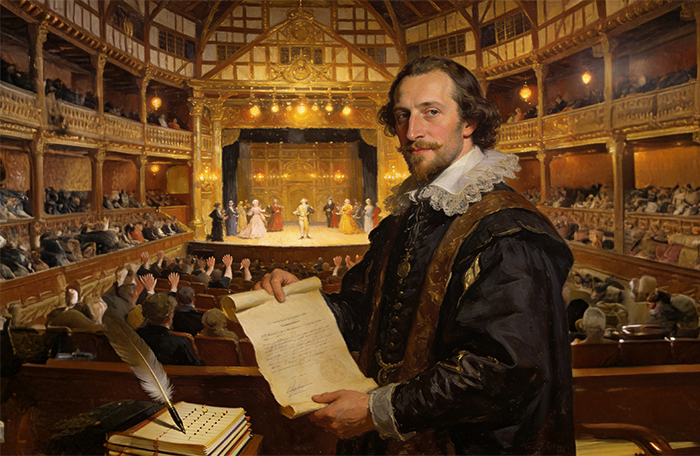
The year 1594 proved pivotal for the dramatist’s financial journey, when he acquired a share in the Lord Chamberlain’s Men (later known as the King’s Men when patronised by James I in 1603), an immensely popular London acting company which would own the Globe and Blackfriars theatres. The timing of his investment could not have been more fortuitous. London’s appetite for theatre was insatiable in the Elizabethan era, as James Shapiro notes in his award-winning book 1599: A Year in the Life of William Shakespeare, “… on average, it’s likely that over a third of London’s adult population saw a play every month.” As a shareholder, Shakespeare took a cut of his company’s lucrative profits and made fortunes out of the thriving theatre business. By 1597, he was already rich enough to acquire New Place, the second largest house in Stratford, which boasted five gables and over 20 rooms.
We should be profoundly grateful for the wordsmith’s financial insight. His keen eye for asset value secured the freedom he needed for artistic creation, generating not only wealth for his family but the most sublime literary corpus for the world. As a company shareholder, he enjoyed a high degree of control over how his plays could be performed, in particular the casting of his own plays. As pointed out by Bart van Es in his superbly written book Shakespeare in Company, Shakespeare could now “plan an entire play by thinking of the capacities of his actors”, allowing him to craft “physically distinct characters”. It was this psychological depth in characterisation which set his work apart as markedly novel and innovative.
Yet, theatre was a volatile business. Outbreaks of plagues and censorship threatened closures. Thanks to his investment acumen, Shakespeare diversified his wealth into real estate in his home town for a steadier stream of passive income. He amassed an impressive 107 acres of farmland that could derive immediate rental income and a cottage in Cottage Lane. This strategic move, along with his stake in church tithes with a guaranteed return, proved instrumental in weathering such turbulent times. In addition to his big Stratford investments, the literary (and investment) genius established his London property portfolio, acquiring properties such as the Blackfriars Gatehouse and another property in Acton. With multifarious income sources, Shakespeare managed to retire from play-writing at just 49. The parallel between the Bard and Antonio, a character from The Merchant of Venice, is striking. Both espoused the idea of diversification in investment: “My ventures are not in one bottom trusted, / Nor to one place; nor is my whole estate / Upon the fortune of this present year: / Therefore my merchandise makes me not sad.”
A poet as well as a pragmatist, the master of the stage did not let his treasure rust. He put it to good use, and in doing so, secured both his art and his legacy.