| |
GLD was required to provide the Government with emergency land transport services, and we became involved in support of the operation from May 1, 2009.
As the first confirmed case of the novel influenza A H1N1 was announced and the quarantine camp at Lady MacLehose Holiday Village was activated, we promptly mobilised our drivers to standby at our transport pool with a view to responding to requests for transport services at short notice.
All drivers responded at once without any hesitation, despite the early hours. They were mainly tasked to convey the guests and hotel staff from the Metropark Hotel Wanchai to the quarantine centres at Lady MacLehose Holiday Village and Lei Yue Mun Park.
Shuttle bus services were also provided for the working staff at the quarantine centres. When the quarantines ended on May 7, 2009 and May 8, 2009 respectively, we arranged vehicles and drivers to convey the guests from the quarantine centres or hospitals to various destinations.
The biggest challenge throughout the period was to plan and secure resources for the land transport services needed for the exit arrangements on May 8, 2009 taking into account the limited lead time and changing requirements.
In addition, the need to ensure safe, orderly and pleasant departure, plus the fact that the whole exit operation was media sensitive, imposed extra pressure on every one of us. |
|
|
|
In view of the large number of guests (about 200) to be transported at the same time, nine commercial coaches were deployed, in addition to three light buses from the transport pool, for the operation at Metropark Hotel Wanchai.
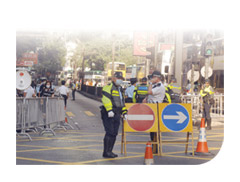
Colleagues were also stationed on site to monitor transport arrangements for the guests leaving Metropark Hotel Wanchai. They co-ordinated and worked very closely with the staff from the Hong Kong Police Force, Home Affairs Department and the coach hire contractor on matters such as the parking of vehicles inside the cordoned area, traffic control and so on. We were relieved to see that all the exit trips for the guests went smoothly and most important of all, the guests left with smiling faces.
The contribution of our drivers, who are dedicated to providing emergency transport services, often goes unnoticed. Despite the risk of infection, either perceived or actual, they never complained and carried out their duties at once and in good spirit.
In this operation, they worked very long hours under tremendous pressure to provide round-theclock transport support services. Many of them were used to being in the spotlight of the media, since most of them had experienced providing transport services during the Severe Acute Respiratory Syndrome (SARS) crisis back in 2003.
Compared to the efforts of other bureaus and departments, what we did may seem to be a small role in the overall operation. Even so, being able to do our bit in containing the outbreak of influenza A H1N1 made all the hard work and sleepless nights worthwhile. |
|